The Best Agentic AI Workflows for Business in 2026: A Practical Guide for Enterprise Leaders
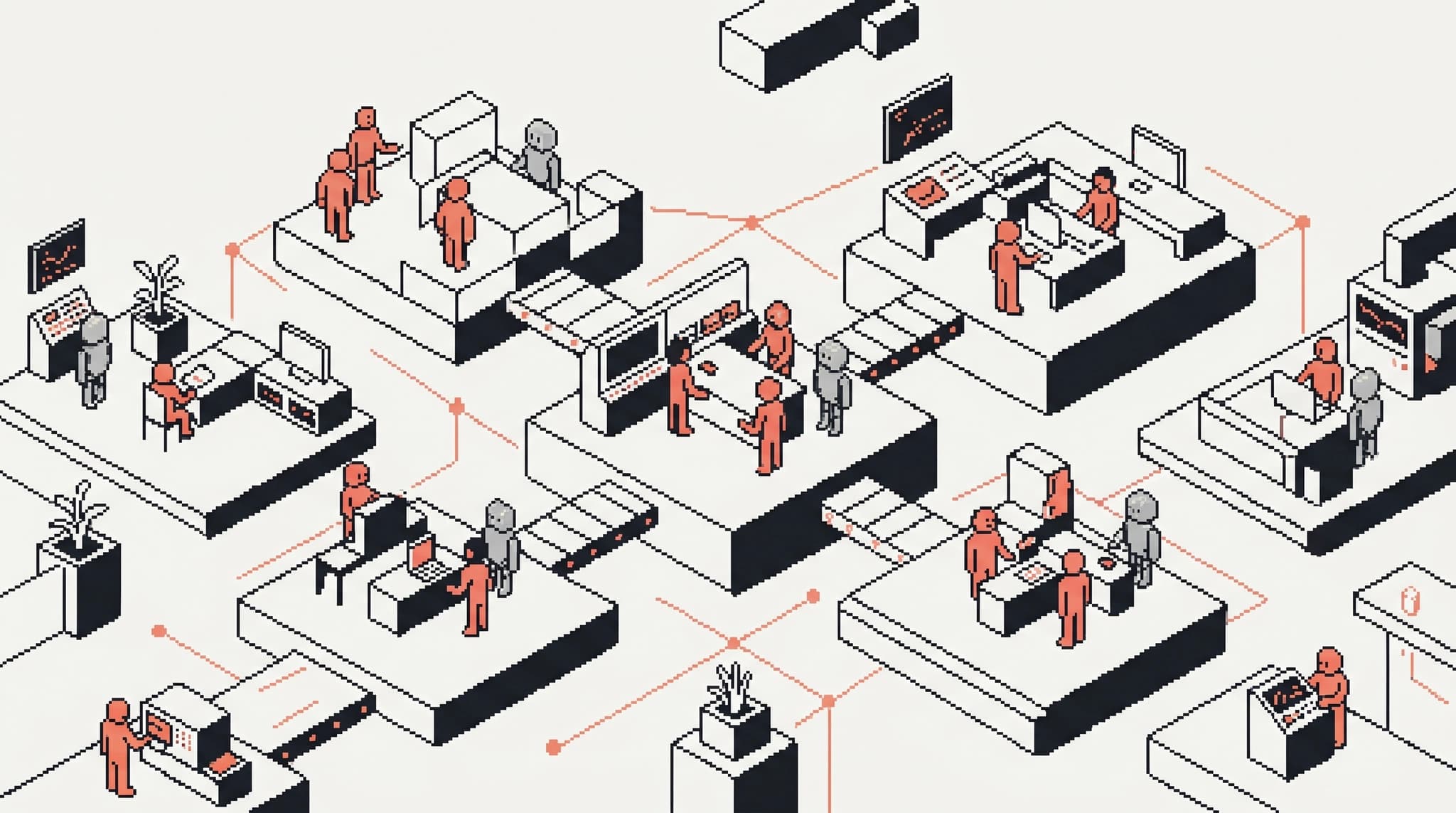
The arguments for agentic AI workflows for business in 2026 are no longer theoretical. The average time savings across business tasks when using an AI agent over manual execution is 66.8%, a figure that makes investment discussions far simpler for undecided management teams. This guide explores the best approaches to agentic AI workflows, where they generate the most measurable value, and explains what separates successful implementations from costly failures.
Key Takeaways
| Question | Short Answer |
|---|---|
| What is an agentic AI workflow? | A workflow where AI agents autonomously plan, execute, and adapt multi-step tasks without requiring human intervention at every single step. |
| Which business functions gain the most from agentic AI in 2026? | Customer service, procurement, marketing automation, financial reporting, and IT service management show the strongest ROI. |
| Are agentic AI workflows safe for enterprise use? | Yes, when implemented with clear governance frameworks, human-in-the-loop checkpoints, and compliant data processing practices. |
| What is the difference between a chatbot and an agentic AI system? | Chatbots respond to single inputs. Agentic AI systems set goals, break tasks into sub-tasks, use tools, and adjust their own plans in real time. |
| How to implement agentic AI workflows without disrupting operations? | Start with a defined pilot project, establish human review checkpoints, and scale gradually using a structured roadmap tied to measurable KPIs. |
| What percentage of businesses use agentic AI in 2026? | 79% of businesses have moved from evaluation to active implementation of AI agents by early 2026. |
| What is AI-human complementarity in agentic workflows? | A framework for precisely identifying when to defer to AI's speed and when human judgment should take precedence, ensuring neither inappropriately replaces the other. |
What Are Agentic AI Workflows, and Why Do They Define Business in 2026?
A standard AI tool waits for instructions. An agentic AI workflow acts on a goal, determines which steps are required to achieve it, uses external tools, checks its own results, and course-corrects without a human having to manage every single decision.
It's a fundamental change in how enterprise software works. Instead of a user typing a query and reading an answer, the agent is briefed on an objective and completes the task from start to finish—whether that involves fetching data from a CRM system, drafting a contract, triggering an approval workflow, or flagging an anomaly in a financial report.
In 2026, agentic AI workflows for enterprise are not a single product. It is an architectural approach, a way of designing digital operations where AI agents function as autonomous employees within a regulated system with human oversight. The key word here is "regulated". The efficiency gains are real, but so are the failure modes when organizations deploy agents without clear boundaries.
The Best Use Cases for Agentic AI Workflows in Enterprise in 2026
Not all business functions are equally ready for agent-based automation. The best results come from areas where tasks are repetitive, data-rich, time-sensitive, and well-defined enough for an agent to operate reliably.
Below are the most valuable use cases we observe across enterprise deployments in 2026.
Customer Service and Support
Agent-based systems can handle the entire resolution cycle for tier 1 and 2 support requests, including diagnosis, database lookups, response generation, ticket routing, and follow-up confirmation. The agent does not wait for a human to hit "send" at each step.
Response speed is the critical factor here. 62% of consumers prefer to interact with an AI agent instantly rather than waiting 15 minutes for a human representative. Speed is not just a convenience feature; it is a competitive differentiator in customer retention.
Financial Reporting and Anomaly Detection
Multi-step financial workflows, such as fetching numbers from multiple sources, reconciling discrepancies, flagging anomalies, and drafting reports, are ideal for agent-based automation. The agent works across systems simultaneously, executing in minutes what previously required hours of analyst time.
Procurement and Vendor Management
Agentic workflows can monitor vendor performance data, trigger reordering processes, compare prices with benchmarks, and highlight alerts for contract renewals, all without manual entry between steps. For large organizations managing hundreds of vendor relationships, this represents a significant operational advantage.
Executing Marketing Campaigns
Agentic AI in marketing goes beyond content generation. A well-engineered workflow handles audience segmentation, asset selection, setting up A/B tests, performance monitoring, and reallocating budget to better-performing variants, all within a single autonomous loop.
IT Service Management
Incident detection, initial triage, knowledge base lookups, implementing patches for defined problem types, and escalation routing can all run through an agentic system. IT teams in 2026 use these workflows to handle routine incidents at scale while freeing up senior engineers for complex architectural work.
Did You Know?
79% of businesses have moved from evaluation to active implementation of AI agents by early 2026, making agentic workflows a current competitive standard rather than a future technology.
Source: business.com
Multi-Agent Systems: The Next Level of Agentic AI Workflows for Enterprise
A single AI agent handles one task. A multi-agent system deploys a coordinated network of specialized agents, each responsible for a specific part of a larger process, working in parallel or sequentially.
Think of it as the difference between hiring a versatile generalist and building an expert team. One agent monitors incoming data. Another interprets it. A third drafts the response. A fourth forwards it for human review, only when strictly necessary. The result is a workflow that handles end-to-end complexity at a speed and scale no single agent or human team can match.
Companies transitioning from single-purpose chatbots to complex multi-agent systems grew by 327% in early 2026. This is not an incremental improvement; it is a structural realignment of how digital work is done.
For business leaders, multi-agent design also raises important governance questions. When multiple agents make interdependent decisions, the oversight architecture must be as sophisticated as the agents themselves. A workflow that operates flawlessly in testing can cause cascading failures at scale if human checkpoints are not correctly positioned.
How to Evaluate Agentic AI Workflows in Your Specific Business Context
The 2026 market is flooded with agentic AI products. Many vendors use the term "agentic" loosely, applying it to what are essentially enhanced chatbots with limited multi-step capabilities. To evaluate true agentic capability, you need to ask precise questions.
We recommend assessing any agentic AI system against the following criteria before committing to an implementation:
- •Autonomy in Goal-Setting: Can the system break down an overarching goal into actionable sub-tasks without manual division?
- •Tool Usage: Does the agent integrate with and use external tools (databases, APIs, file systems) within the workflow loop?
- •Self-Correction: Can it detect when a step has failed or produced an unexpected result, and adjust its approach accordingly?
- •Memory and Context: Does it retain relevant context across a long workflow, not just within a single conversational window?
- •Escalation Logic: Does it know when a decision requires human review, and hand it over clearly without losing context?
- •Audit Trails: Does every agent action produce a readable log enabling compliance checks?
- •Data Handling: Where is the data processed? For organizations operating under GDPR or national data sovereignty requirements, this is non-negotiable.
The final point is especially critical in 2026. As agentic systems gain access to sensitive business data, the question of where this data is sent and how it is stored is a compliance and reputational risk, not merely a technical preference.
5 Steps to Implement Agentic AI Workflows in Enterprise in 2026
A successful implementation of agentic AI workflows in enterprise in 2026 follows a structured sequence. Organizations that skip steps, particularly the governance and skills development phases, consistently report higher failure rates and lower realized value.
A concise visual guide outlining the five steps to implementing agentic AI workflows in enterprise. Use this as a quick reference for deployment in 2026.
- Identify a clearly bounded pilot use case. Choose a process that is repetitive, data-driven, and low-risk if the agent makes a minor error. Revenue-impacting or customer-facing processes are better left for phase two.
- Map the current workflow in detail. Document every step, decision point, data input, and exception case. Agents need a clear problem definition; ambiguous workflows create unreliable agents.
- Design checkpoints for human oversight. Decide exactly which decisions require human review before the agent proceeds. This is not about distrusting technology; it’s about maintaining appropriate accountability at the right moments.
- Run a structured pilot with measurable KPIs. Define success metrics before deployment, not after. Track time to completion, error rate, escalation frequency, and user satisfaction in parallel.
- Build team capacity alongside the technology. The organizations with the highest ROI on agentic AI in 2026 are those that have invested in upskilling their teams to work *with* the agents, not just alongside them. Humans who understand what agents can and cannot do are far more effective at overseeing, correcting, and improving these systems over time.
Governance and Risk: Why 40% of Agentic AI Enterprise Workflows Fail
The growth figures for agentic AI implementation in 2026 are impressive. The failure numbers are a necessary counterweight. 40% of agentic AI projects are expected to be cancelled by 2027 due to rising costs and a lack of clear governance frameworks.
This is not a technological problem. The agents work. The root cause is organizational. Projects collapse when:
- •The business objective is vague, and the agent lacks a reliable success criterion to optimize against.
- •Governance structures are absent, meaning agents make critical decisions without audit trails or escalation paths.
- •Deployment is treated as a one-time install rather than an ongoing system requiring monitoring, retraining, and fine-tuning.
- •Cost models underestimate operating expenses, including compute, integration maintenance, and human review time.
- •Cultural resistance is ignored, with employees viewing agents as replacements rather than competent colleagues that shift the nature of their work.
Organizations succeeding with agentic AI in 2026 treat governance as a design requirement from day one, not a compliance chore bolted on at the last minute. They also invest in truly enabling their teams to work with agents rather than expecting the technology to deliver value without human partnership.
Did You Know?
40% of agentic AI projects are expected to be cancelled by 2027 due to rising costs and lacking clear governance, making the deployment strategy just as important as the choice of technology.
Source: beam.ai
Human-AI Complementarity: The Framework That Makes Agentic Workflows Succeed
The most enduring competitive advantage in 2026 won't come from deploying the most agents. It will come from deploying them with precision, clarifying where AI's speed and scale add value and where human judgment is irreplaceable.
We call this AI-Human Complementarity: a structured framework for mapping each element of a workflow to either AI execution or human decision-making, based on the nature of the task rather than just the technology's capabilities.
Some decisions have characteristics ideally suited for AI: they are repetitive, data-intensive, time-sensitive, and have objectively measurable outcomes. Other decisions are contextual, ethically weighted, novel, or relationship-dependent in ways requiring human reasoning and accountability.
A practical implementation of this framework looks like this:
| Task Type | Best Handled By | Rationale |
|---|---|---|
| High-volume data processing | AI agent | Speed, consistency, zero fatigue |
| Novel exception handling | Human with AI support | Requires contextual judgment |
| Routine customer inquiries | AI agent | Speed advantage, pattern-based resolution |
| Sensitive escalation decisions | Human, informed by AI | Accountability and relationship context required |
| Drafting compliance reports | AI agent, human review | AI drafts at scale, human validates accuracy |
| Strategic planning | Human, AI-assisted analysis | Values, priorities, and long-term assessment required |
Organizations that carefully map this out before deploying agents consistently achieve higher returns and lower error rates than those automating based on technical feasibility rather than strategic sense.
What to Expect from Agentic AI Business Workflows in the Next 12 Months
The evolution of agentic AI workflows for enterprise in 2026 points toward deeper integration rather than wider proliferation. The growth phase of deploying isolated single agents is yielding to the far more demanding task of connecting them into cohesive systems across the business.
By late 2026, 40% of enterprise applications are expected to feature task-specific AI agents. That is up from under 5% in 2025. For most large organizations, this means the question is no longer whether to adopt agentic workflows, but how to integrate them with existing software architecture, governance structures, and team capabilities.
We expect three developments to shape the agentic AI landscape for the rest of 2026:
- •Standardized agent communication protocols will emerge, allowing agents on different platforms to reliably exchange context. This is currently a major bottleneck in multi-agent system design.
- •Regulatory clarity on agent liability in regulated industries (finance, healthcare, legal) will accelerate adoption in sectors that have held back due to compliance uncertainty.
- •Workforce integration frameworks will become a primary competitive differentiator. Organizations investing in structured employee upskilling programs will extract significantly more value from their agent infrastructure than those treating deployment purely as a tech project.
"The most successful AI transformations begin with a deep understanding of the humans they serve. The technology enables the outcome; the humans determine if that outcome has any lasting value."
Choosing the Right Agentic AI Workflow Approach for Your Organization
There is no single universal, optimal agentic AI workflow architecture for enterprise in 2026. The right choice depends on your organization's data infrastructure, compliance requirements, team maturity, and the specific processes targeted.
The table below provides a practical framework for mapping your organizational context to a suitable starting point.
| Organizational Profile | Recommended Starting Point | Key Considerations |
|---|---|---|
| Enterprise with mature data infrastructure | Multi-agent system with defined orchestration layer | Governance architecture is the critical investment |
| Mid-sized organization, early AI adoption | Single-agent pilot in a high-volume process | Team capacity building is as important as the tech |
| Regulated industry (finance, healthcare) | Agent with full audit logging and human escalation paths | Compliance frameworks must be active before deployment |
| Organization with strict data sovereignty rules | Locally hosted or regionally compliant agent infrastructure | Processing location is an unyielding constraint |
For organizations operating under GDPR or local data laws, data sovereignty is particularly critical. An agent system processing sensitive business data via infrastructure outside your jurisdiction creates a compliance risk no productivity gain can justify. Many tech vendors gloss over this in sales material, making it a point requiring direct scrutiny in procurement.
Conclusion
Agentic AI workflows for enterprise in 2026 represent a significant structural shift in how business operations are executed. The productivity data is compelling, the adoption curve is steep, and organizations building thoughtful, governed, and human-centric deployments gain real competitive advantages in velocity, cost-efficiency, and decision quality.
The defining difference between the 60% succeeding and the 40% failing isn't about which technology is chosen. It’s whether implementation is treated as an organizational capability-building effort, rather than merely a technology installation project.
Making agentic AI workflows work in 2026 requires investing in clear governance from the start, designing human oversight that is precise rather than performative, and building the team skills needed to collaborate effectively with increasingly capable AI systems. The tech is ready. The question is if your organizational foundation is.
Frequently Asked Questions
What is an agentic AI workflow, and how does it differ from regular AI automation in 2026?
An agentic AI workflow deploys AI agents that set goals, plan multi-step tasks, use external tools, and self-correct without human intervention at every stage. Routine automation executes predefined scripts. Agentic workflows adapt to new information and handle exceptions dynamically, making them far better suited for complex business processes in 2026.
Is agentic AI worth the investment for a mid-sized business in 2026?
Yes, when applied to the right use cases with proper governance. An average time savings of 66.8% per task makes ROI calculation straightforward for high-volume, repetitive processes. The risk lies in deploying without a structured implementation strategy, the primary driver for failed projects.
What are the most common mistakes companies make when adopting agentic AI workflows?
The most prevalent mistakes are deploying without clear success metrics, skipping governance and audit trails, treating team upskilling as optional, and underestimating ongoing operational costs. Starting with too broad a scope is also frequent. Focused, tightly bound pilot deployments consistently outperform massive rollouts.
How do I ensure my business data remains secure using agentic AI tools in 2026?
Verify where your data is processed and stored, check if the vendor complies with regulations like GDPR, and ensure the system produces auditable logs mapping all agent actions. For organizations with strict data sovereignty mandates, locally hosted or regionally compliant infrastructure is the only responsible choice.
What can a multi-agent AI system do that a single agent cannot?
A multi-agent system deploys specialized agents working in parallel or sequentially on different parts of a complex process. This enables end-to-end workflow automation exceeding single-agent capacity. In 2026, multi-agent architectures manage processes like full procurement cycles, integrated marketing campaign oversight, and cross-system financial reconciliation—tasks impractical for one agent.
How long does it take to deploy an agentic AI workflow in a large enterprise?
A tightly scoped pilot deployment typically takes six to twelve weeks from process mapping to live monitoring. Enterprise-scale multi-agent systems requiring full governance architecture, multiple existing platform integrations, and team upskilling programs realistically require four to nine months. Rushing this timeline is a leading cause of failed agentic AI projects in 2026.
Will agentic AI replace human employees in business processes?
Enterprise implementation data in 2026 consistently shows agentic AI reshaping work rather than eliminating it. Agents manage high-volume, repetitive, data-heavy tasks, while humans focus on judgment-required, relationship-dependent, or strategically novel work. Organizations embracing this as a complement rather than replacement perform better on productivity metrics while maintaining stronger employee engagement.